-->
Showing posts with label Essay. Show all posts

Saturday, June 27, 2015

The Gaining Game


Benjamin Franklin famously said, “Nothing can be said to be certain, except death and taxes.” I propose amending that to “death, taxes, and obesity.”

We all face the dreaded reality. Past early adulthood, for reasons that are endlessly debated yet little understood, most of us start gaining weight. A battle begins, from which there is no escape, no respite, no letup, and victory is when you hit the status quo. Put simply, in the present day and age, gaining weight is easy; getting rid of it is hard.

For me, the battle began the day I landed in America. Stepping off the plane on a crisp December afternoon in Atlanta, I caught a shuttle and reached the university town. A cousin, with whom I stayed the first few days, graciously extended a cup of tea. Make that a very large cup of tea, American size. Laden with whole milk and ample quantity of sugar—the kind I craved for but never got in India. Sugar was pricey and rationed out in strictly monitored teaspoonfuls in our household. The concept of whole milk had become a distant memory the moment we shut down our cowshed and outsourced milk delivery to either Devuamma, a local small-scale dairy owner, or the impersonal state-backed Milma cooperative. By adding a copious amount of water, both sources ensured our milk was quite a ways away from being “whole”; we were in no danger of gaining weight from milk fat.

The rest of the diet was equally sparse, and vegetarian. Being active was built into the daily routine—my brothers walked to their school two miles away, mother walked a similar distance to the bus stop, and I biked halfway to the campus before boarding the college bus. And it showed: we were lean, without a hint of fat on us. A family photo taken before I departed to the U.S. captured the situation well. This picture would later play a crucial role in motivating me to take the fat combat head on.

Back in the U.S., the whole milk tea was just the beginning. Devoid of cooking skills, my diet initially consisted of sliced bread, jam, butter, apples, whole milk, Swiss Miss, coke, and Mars bars. A few month into this diet though, I rapidly grew in girth and in short order was forced to shop for bigger-sized clothes. The move to a regular diet of rice and vegetables resulted in near disaster, as I have written in my Kitchen on Fire. My biomarkers nose-dived. On doctor’s advice, I began a running regimen that was at best inconsistent. Worries about finishing graduate school and landing a job outweighed concerns about the accumulating kilos.

Marriage further tipped the balance in favor of padding on the pounds. To get back on a diet of tasty cuisine was a welcome relief after years in the culinary wilderness. My wife urged exercise, but “I don’t have the time,” was my refrain. I knew I hit the lowest point (or the highest, depending on the point of view), when I went to Kerala for a visit. I was puffed up and rotund, inviting compliments from all around: “Ippo nalla thadi okke vachu nannayittirikkundallo!” (You have put on weight and are looking good!).

By then I had landed a steady job and was on a normal office goer schedule. So, back in the States after the visit, I began a more focused effort to get matters under control. In a couple of years, a combination of regular jogging and moderation at the dinner table helped shed the excess pounds. I knew this because, on my next visit to Kerala, my appearance evoked instant disapproval and deep concern. One older lady, with a new found interest in my welfare, asked: “Ayyo monu valla maharogam vallathum vanno?” (Oh son, did you come down with a terrible illness?).

Now, let me be honest. I am going overboard describing my attempts to control weight as a struggle. At the heaviest, I might have been 12-15 pounds over my ideal weight. My point is that shedding those extra pounds took a focused effort and keeping it down has taken a surprisingly high amount of work.

I have the numbers to prove it. Take a look at the chart below. It depicts a line graph of 171 weight measurements I took over two years and three months, from February 2013 to April 2015. The weights were taken on the same scale under identical conditions. The blue wiggly line plots the weight in pounds. The red flat line is the average weight over the period. I have excluded the weight level (how many pounds) from the chart because that information is not important to the story; only the trend is. The range of fluctuation is narrow. Most of the wiggly line is contained within a range of 4 pounds.
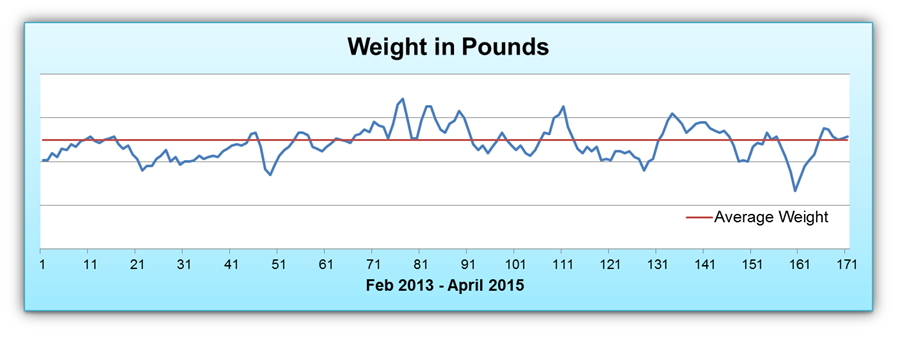


By all appearances, the weight has held pretty steady. Or has it? Look at the next chart. Everything else in this chart stays the same as in the previous chart, except the red line. The red line is now the linear trend “fitted” to the data. The line has a slight upward slope, meaning the weight is creeping up1. Not by much, under half-pound over the period, but up, not down!


Now, all this is rather bland. What is striking, and the main point let me reiterate, is the high amount of effort that has gone into keeping the weight steady. Typically, I would say, five days a week of vigorous exercise, plus careful attention to eating. Yet, the trend is up, not down. Perhaps this bears out the notion that as you get older, you have to work harder and eat even less to keep the weight down.

Setting aside the effects of aging, none of this was remotely necessary while growing up in Kerala. The environment and the circumstances almost dictated one remain thin. No extra effort was needed. How things have changed (for more on this, read my Summer in Kerala).

The catalysts needed to pull off long-term weight control are motivation and tenacity. For me, these came soon after I returned from that India trip during which I was roundly complimented for my plumpness. My wife was rummaging through some old documents in a box that hadn't been opened after I had packed it when I moved from the University to take up my new job in Washington. Perhaps she was fishing for love letters from my former girlfriends but instead she found the family picture taken at the time I left for graduate studies in the U.S.2

“Is this you?” she asked, pointing to my former slimmer self.

“Yeah, that’s me,” I said. “Why are you going through my files?”

She ignored my question and continued to study the black and white photograph.

“Man,” she said, “you have gained lot of weight!”

I pinned the photograph on my bulletin board and joined the battle to win the gaining game.


1 The fitted line is y = mx + b, where x is the measurement period from 1 through 171, y is the corresponding weight in pounds, m is the slope coefficient and b is the y-intercept. The estimated m=0.0021 with a t-value of 1.91. The R-squared for the estimated equation is 0.021.

2 Meanwhile, the love letters are in a box labeled "Utility Bills." The secret is safe here because I place the same low odds on her reading a footnote in my blog as on her opening a box labeled "Utility Bills."

Monday, August 26, 2013

English Minglish


We were recently hiking in the Great Smoky Mountains when it started raining. I handed out ponchos to the members of our party. As my friend struggled to get it on, she asked:

“Where’s my head?”

Good question! But let us try not to get too clever here. She was asking about the opening in the poncho to poke one's head through. We had a good laugh at her choice of words. Which reminded me, she got away with botched expression because she was in America. Back in India, we wouldn’t have let her off the hook that easily. She risked being labeled as wanting on English grammar and vocabulary and kicked out of the “in” group.

We all have reasons why we love this country. One of mine is the American preference for what works and what gets done as opposed to the protocols and procedures of how. In the realm of communication, this translates to a remarkable tolerance for a range of speaking styles. Americans prefer immigrants learn and speak English, but that’s about it. As long as you are able to communicate your ideas and follow what’s being said, the rest is business as usual. How often have you heard Americans make fun of your grammar or fluency? Accent maybe, in sitcoms or stand-ups. But grammer? Hardly.

Take Bob, our kitchen remodeler. At 6 feet 6 with a generous helping of lean muscle mass, he cuts an imposing figure. He could have rolled over laughing at my Malayalee English or Minglish without fear of reprisal once the contract was signed. But it was as if he didn’t notice. We had long conversations over the six-week period he worked on our kitchen. Aside from an occasional, “what’s that?” or “say that again,” we had uneventful communication.
Bob redoing the kitchen
I'd be a fool, though, to think he wasn't aware of the vagaries of my Minglish. Surely, he must have noticed my “vindho,” and “coundertop,” not to mention “I am vanding to move the refrigarater,” but he accepted that as normal part of doing business with an immigrant. I know this because, he told me with some amusement about his painting crew.

Bob didn’t paint. Instead he outsourced that to a Korean contractor named Mr. Lee. Mr. Lee presented a far bigger linguistic problem to Bob than I did. The little English that Mr. Lee spoke, he mumbled, barely opening his mouth. But what made matters worse was this: Mr. Lee’s workers were three Hondurans, only one of whom spoke what can be loosely qualified as English. It was quite a theater when Bob, Mr. Lee, and the three Hondurans got together to discuss the modalities of painting our kitchen. Throw a Minglish speaker into the mix and you have all the ingredients for the experience of a lifetime. We instinctively fell back on the adage that “actions speak louder than words.”
After Bob's magic
You see, for a Malayalee—and by that I mean native Malayalam speakers, not the ABCD Mayyayees, or the television anchor wanna-be-ABCD Mayyayees—good spoken English is an elusive dream, destined to remain for ever out of reach. Such is the hold growing up speaking Malayalam has on your tongue.1 The words won’t flow, the grammar fails, and the accent never goes away. Yet, the aspiration remains.

Takes movies or television, the guardians and propagators of our culture; yeah, I agree, we are in safe hands. Their rise or fall at the box office or at the ratings game depends on how much English they can squeeze into the dialogue. The more an anchor feigns ignorance of Malayalam by interspersing her inane narration with English words, the higher the program rating climb. The more she anglicizes the Malayalam words, the larger her fan club gets. In the movies, the hero stands apart from his shinkidis (acolytes) by his command of English. He always narrates his കിഡിലന്‍ (fiery) dialogue to the villain first in English, and then, after a comic moment where the villain looks stupid failing to understand what was said, he repeats the dialogue in Malayalam. The latter action is necessary not just to put the villain in his place but to help the audience along. You may argue that there are no more such heros in the “new generation” movies. Granted. But these paeans to plagiarism prove my point—they are the epitome of Minglish run riot.

In college as in movies, few things set people apart as their command of spoken English. This made social life difficult for some. If you wanted to befriend one of the “ashposh” city girls, you had to pass some hurdles. It helped if you wore jeans and could master some basic facts about western music. But two requirement were non negotiable: play cricket and speak English. These hurdles proved insurmountable to most. Things came to a head for Bhaskaran from our junior batch. Three years of life in the college and hostel had done little to erase the village imprint on his attire, attitude, and articulation. Yet, the poor fellow threw caution to wind and went after one of city girls. For months on end did he pursue the fine lass with every trick in the book. Finally, exasperated, we seniors read him the rule book. Bhaskaran fell to his knees, threw up his hands, and spoke thus:

“Friends, I can round up some rupees and buy a jeans, hang out with the town folks and memorize some things about western music. I can even put on the pads and hit the wicket. But speak English? No way!”

The expectations and scrutiny must have been a heavy burden to our college professors. We judged them not by their command of the subject matter but by their ability to lecture in impeccable English. This turned several of the good ones from lecturers into readers, unwilling to step outside of their written notes. The tables turned when I became a graduate assistant and was assigned a teaching stint at a university in the South. Suddenly, I faced all the fears at once: vocabulary, fluency, grammar,spelling, and yes, the most dreaded one, accent.

I groped my way through the first few lectures, relaying on charts, symbols etc., to keep attention away from my Minglish. And then the realization hit me. These American kids didn’t care. Those who were paying attention were too focused on the material, microeconomics, to care about speaking style. Those who who weren’t paying attention were too focused on other priorities like sleeping and didn’t care either. And finally, a third group didn’t care at all because they were pursuing activities outside the classroom. A few gentlemen from this third group did change their tune when they got an F; they complained to the department head about the TA’s poor accent. The head asked them to enumerate the areas they had most difficulty with: was it indifference curves, marginal rate of substitution, or the law of diminishing returns? Upon seeing baffled looks and silence, he invited them to repeat the course and showed them the door.

That was a liberating realization. All you had to do was get your ideas across in a reasonably comprehensible way and you could transact business without being ridiculed. I gave up any pretensions about an American accent then and there. No more rolling my tongue or twisting the ‘r’ in vain attempts to mask my Minglish.

But making a similar transition in written prose, I admit, has been harder. You see, we come from a ബുദ്ധി ജീവി (intellectual) tradition that equates abstruse prose with scholarship, flowery writing with style, archaic British expressions with depth. The keepers of this tradition came down hard on me in high school. In 11th grade, we are asked to speak on our career choice. As any good son would, I spoke about my aspiration to become a doctor. I said my goal was to pursue a medical career. Lordy lordy! This triggered the ire of the English overlords. “Medical career?” they seethed. “You mean you want to become a compounder, a medical store clerk?” “No,” I said, “although there is nothing wrong with those occupations. I want to become a doctor.” “Oh, you mean you want to pursue a career in medicine?”

Medical career = componder, Career in medicine = physician. What style! How deep!

This hounded me until I came to America to study economics and joined the American Economic Association. This wasn’t an association of penny-pinchers or retail clerks, although there is nothing wrong with these pursuits. This is an association of professional economists, mostly with a doctorate. And soon enough, I came to know about the American Medical Association and the American Physical Society. Too bad physicians and physicists, I am afraid our colonialist friends won’t recognize your memberships in these outfits. You will be dismissed as compounders and body builders.

If you are a Malayalee, you couldn’t have escaped noticing the artful use of dense-sounding prose by our underemployed party theoreticians. They were among the first to latch on to Minglish’s potential. Though staunch anti-colonialists and defenders of Malayalam, they quickly realized that casually throwing in a few English words in their discourses on dialectical materialism worked wonders in keeping the worker bees hooked to the party line. Suddenly, corruption looks like compassion, murder, an act of mercy.

Somehow, I suspect one of our അനുഭാവി (party sympathizer) is behind the following episode. Jack Valenti, special assistant to Lyndon Johnson and longtime president of the Motion Picture Association of America, talks about a frightening experience when he attended a film festival in India. At one of the seminars, an expert rose up (stroking his beard I suppose) and spoke about the meaning of fascination with movies:

The theory that there exists a Cartesian polarity between arbitrary aesthetic signs and total realism necessarily led to quantitative conclusions and meaningless oppositions: the proliferation of detail as against metaphysical truth, where quality cannot be seized, the fluidity of mise-en-scene as against against meter montage, the existential tension of suspense in Hitchcock, as against the tragic release from pity and fear.

Now this, an American would object. Mr. Valenti was polite and didn’t say it, but I will.

What the &%*$@ are you talkin’ about? Get with the program, dude.


1 In Names, I talk about what happened when I attempted a social introduction by extending my hand to a graduate student saying "I am Jay." From then on he went about addressing me as MJ! Eventually, I mustered enough courage to take this atrocity head on. At a reunion, I reintroduced myself more forcefully in a Bond-like manner: "I am Variyam. Jay Variyam." That did the trick.

Wednesday, September 8, 2010

Names


Bhagwan fitted suit
Back in school, we had a funny story about the guy who went overseas and returned, introducing himself as R.A. Jappan. Turns out, in the days before his sojourn, the fellow was merely good old Rajappan. I thought about this story as I was shopping for a suit at the Kuppenheimers in Conyers, GA, when I was a graduate student. Being a PIGS (Poor Indian Graduate Student – a moniker no doubt coined by a vengeful ABCD), I was compelled into this indulgence due to requirements of a formal research presentation. I was quite relieved, therefore, to be accosted by a Desi-looking salesman. I wanted all the help I could get to find that cheapest suit at the highest discount. He introduced himself as Bob Chagh, sporting a name tag to prove it. As I hesitated thinking … and I am Don Klinghoffer …, he apologetically muttered something in Hindi, the gist of which was that the sales job required a slight amendment to his name and he is actually Bhagwan Chaghwani.
Quite a leap from Bhagwan to Bob. But, unlike in the days when I heard the R.A. Jappan story, I was in no mood to poke fun at Bob. It was not just that poor Bhagwan was fighting for customers in the heart of the Deep South, an area not exactly hospitable to names with Rajasthani root. After all, within a matter of a month after my arrival in the country, my own name had morphed from N. V. Jayachandran to Jay Variyam. That sobering episode had left me with plenty of empathy for name changers.

P V Narayanan became Pavanayi
Our general tendency is to sneer when we hear a Shankunny becomes Shank. We think of Pavanayi in Naadodikkattu (a Malayalam movie) who explained to Thilakan’s character that his real name, P.V. Narayanan, didn’t carry enough “weight.” But, in all likelihood, there is more than vanity involved in how a name gets altered. I admire Pavanayi for his honesty, but I wouldn’t fault him if he changed his name after one of his “assignments” brought him to America. Have you tried getting an American to say Narayanan properly? I have. The resulting mangled mess would be so depressing and damaging to the self-esteem of those so named that I would fully understand P. V. Narayanan’s impulse to pass off as Pavanayi.
I was perfectly happy as N. V. Jayachandran. However, while filling out the passport application for my F-1 Visa, the clerk instructed me to spell out my family name. Now, I am no onomatologist, but I had learned enough about naming conventions to know that Jayachandran can’t be my family name. So I reluctantly spelled out Njerukkavil Variyam. To avoid the prospect of scaring the hell out of the unsuspecting Georgia Social Security office clerk, I didn’t expand the ‘N’ when I filled out the form to get my social security number. Thus, on official records, I became Jayachandran N Variyam. From there, it was only a small step to Jay Variyam as my Chinese classmates—who were perplexed by my first name; talk about irony!—took to calling me Jay. I tolerated, noting that all of them, without the slightest remorse, had slid comfortably into their new avatars as Ken, Charlie, Angela, Francis, and Peggy! My new name stuck. And if you press me today, I will admit that it has a nice ring to it.

Evolution of a name
But if you think that my name-related woes ended there, you would be sorely mistaken. Shortly after Jayachandran became Jay, I introduced myself to a fellow graduate student saying, “I am Jay”. Now, I am not sure how those two simple words could be confusing. But, as I have discovered over the years, my Malayalee accent is a major impediment to speaking clear English. And simple remedies such as twisting the tongue and replacing all the ‘R’s with ‘Zh’s just won’t cut it. In any case, after that brief introduction, my acquaintance started calling me MJ—and I am certain it was not in tribute to my musical talent. Years later when we met again, I reintroduced myself, this time more assertively as “I am Variyam, Jay Variyam.” Although it wasn’t in the same league as “Bond, James Bond,” it did the trick. The look of disappointment on his face in having misled him all these years was unmistakable.
While changing one’s birth name remains anathema to many Malayalees, things have begun to ease. Businessmen dreaming of riches running call centers quickly realized that having Balasubramanian answer the phone call from Chattahoochee, TN is a guaranteed road to quick bankruptcy. Under such pressure, there is less resistance to a brahminical Moorthy becoming a more business-like Murphy, a quite remote prospect in any other circumstance. Granted party theoreticians will see a sinister CIA plot behind such moves, but a practical course starts looking more attractive when you have to actually work and earn a living.
The antagonism towards changing names stems more from certain cultural norms rather than blind hostility to Westernized names. Because of its unique history, Kerala leads India in the diversity of names. We are equally comfortable with Peter and Padmanabhan as we are with
Girly Anto became Gopika
Damodaran and Dominique or Kumaran and Cletus (who ably served as our wellpump repairman for many years). Plamena and Padmavati are good neighbors without ever falling under the spell of name-related animosity. Sadly, a reverse undercurrent is eroding some of this diversity as traditional names are giving way to Indianized names. Movie stars have added a touch of glamour to this trend. Nary an eyebrow was lifted when Girly became Gopika. The Abrahams, Michaels, Zacharias, of the erstwhile generation are today typically the Anands, Manojs, and Santhoshs. Authentic Malayalee names such as Gopalan, Sudhakaran, and Pankajakshan have succumbed to rampant North Indianisation and are now commonly foreshortened as Gopal, Sudhakar, and Pankaj.
The onslaught of modernization and the proliferation of nuclear families and mixed marriages are wrecking havoc with whatever is left of the naming conventions that existed in Kerala. Lately, a new trend has emerged in which women are taking their husbands' first names as their last names. Tessy Mamplackal shed the aristocratic family name and became Tessy Baby after
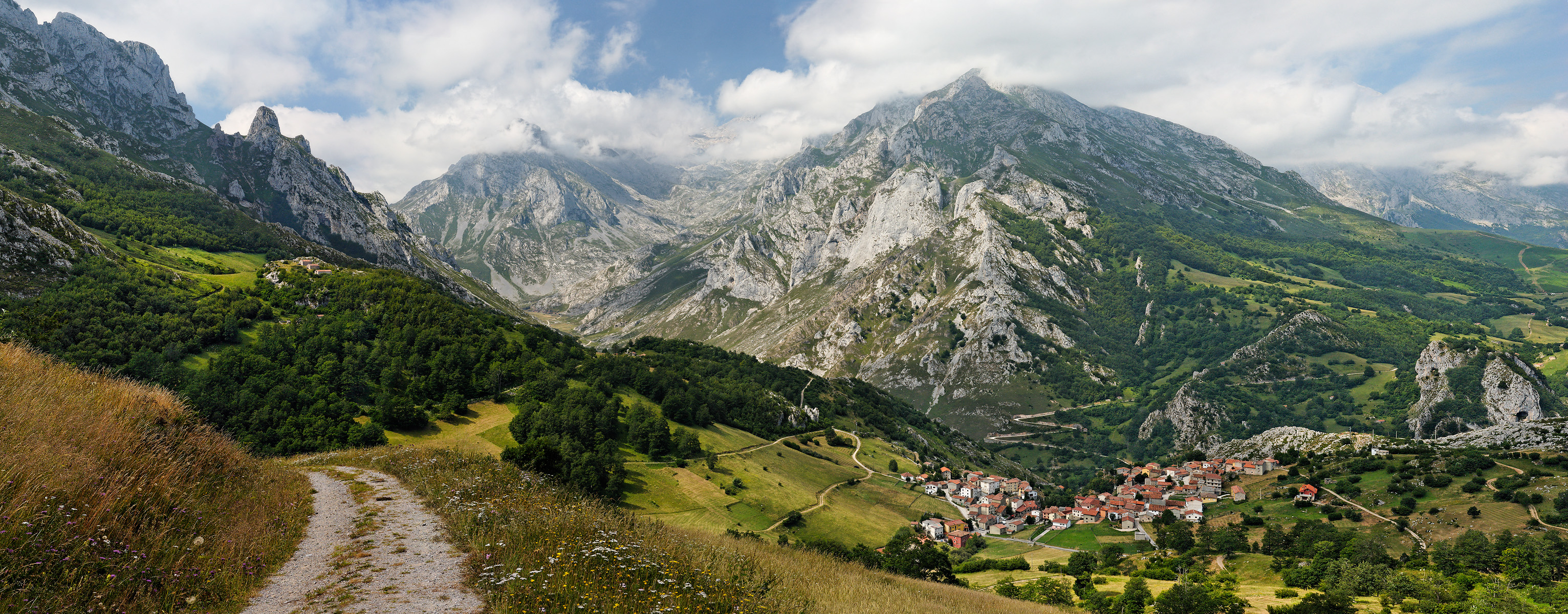
Cantabrian Mountains
her recent marriage to Baby Verghese. It is hard to fathom what factors led her to favor Baby over Verghese, a name steeped in history tracing back its origin to Cantabria, Spain.
But with respect to confusion and disharmony in naming conventions, none can beat the Variyar clan. Much of the disagreement can be traced to the uncertainty brought on by transliteration from Malayalam to English—specifically, the choice between V and W, a perpetual source of linguistic misery for Malayalees. Some Warriers spell their last name with a W, others with a V, and some, reeling from the dilemma, go with both in the same name: As in K. V. Chakrapani Warrier. If Mr. Warrier is a descendent of Kizhakkepurathu Variyam, should he be a Variyar or a Warrier? Or perhaps Varier? I am not making this up. It is all on the record anywhere names are printed. You could look it up. I am glad to have played my little part in carrying the tradition forward.